
Outstation Cab Route
Gurgaon to Vrindavan Taxi Service
Gurgaon to Vrindavan is an easy same-day trip on flat road, though the day is best planned around the temple timings rather than the driving time.
Route Overview
Gurgaon to Vrindavan by Road
Vrindavan is the main draw for most travellers on this route, with Banke Bihari Temple, Prem Mandir and ISKCON forming the usual circuit. Mathura lies 12 to 15 km away and is almost always included, so in practice this becomes a Braj trip rather than a single-temple visit.
From Gurgaon the drive goes south through Faridabad and Palwal onto the Delhi-Agra highway, which keeps the journey simple and avoids crossing Delhi. The road is flat throughout and the travel time depends mostly on how early you start.
The detail that catches first-time visitors out is that Banke Bihari Temple closes for several hours in the middle of the day. Planning the day around its reopening, and keeping Prem Mandir for the evening when it is lit, makes for a far better trip than working purely around drive times.
Travel Details
Distance, Time and Route Highlights
The drive is straightforward flat highway with no difficult sections. The Faridabad and Palwal stretch at the start is where traffic can slow you down; after that the road runs clear. Inside Vrindavan the roads are narrow and heavily used by e-rickshaws, and movement near the main temples slows considerably during darshan hours.
Banke Bihari Templedevotional day tripsMathura-Vrindavan travel
Route Stages
Gurgaon to Vrindavan Route Stages
- Gurgaon → Faridabad — Local traffic here is the main early-morning variable
- Faridabad → Palwal — Joins the Delhi-Agra highway
- Palwal → Kosi Kalan — Clear highway running
- Kosi Kalan → Vrindavan — Narrow local roads at the end; cabs park away from the temple lanes
Stops Along the Way
Places to Stop Between Gurgaon and Vrindavan
- Highway dhabas near Palwal (dhaba) — Usual breakfast and washroom halt on the way out
Places to Visit
Top Attractions in Vrindavan
- Banke Bihari Temple — This is Vrindavan's main temple, and while it sees large crowds throughout the day, it closes for several hours around midday, so it's worth checking current timings before arriving to avoid a wasted trip. The practice of periodically curtaining the deity gives the darshan experience here a distinctive rhythm.
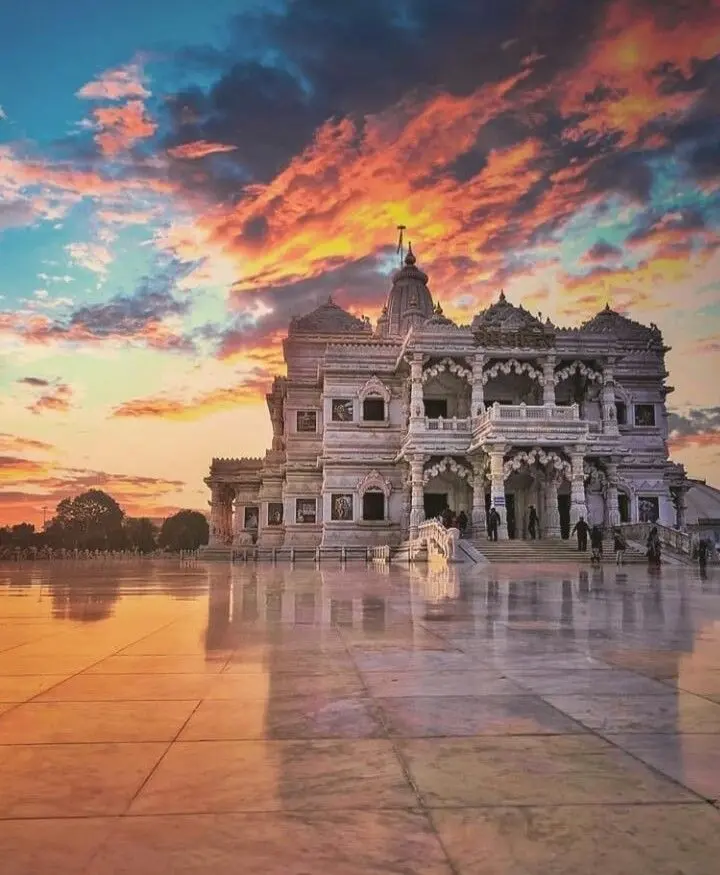
- Prem Mandir — This modern temple is best seen in the evening, once it's fully lit and the fountain show in front of it begins. Its marble carving and evening illumination together set it apart considerably from Vrindavan's older, more traditional temples.
- ISKCON Vrindavan — Known as well by its formal name, Krishna Balaram Mandir, this temple is calmer and easier to reach than the crowded lanes around the old-town temples. It draws a considerable number of international visitors alongside local devotees.
- Nidhivan — Tied to local legend, this quiet, forested grove has limited opening hours, making it worth checking the current schedule before planning to visit. Its calm atmosphere contrasts clearly with the busier temple complexes elsewhere in town.
- Radha Raman Temple — This older temple sits within the narrow lanes near Banke Bihari and tends to draw a steadier, more local crowd rather than large groups of tourists. Its smaller scale and quieter setting give it a different character from Vrindavan's more visited sites.
Good to Know
Best Time to Travel and Road Notes
Best season: October to March is the most pleasant. Holi in February or March and Janmashtami around August or September bring the largest crowds of the year to Vrindavan.
Road note: Fog in December and January can slow an early start. Cars are not permitted in the lanes closest to Banke Bihari, so expect to park at a distance and continue on foot or by e-rickshaw.
Cab Choices
Cab Options for Vrindavan
A sedan is comfortable for this route given the flat, easy road. Families of five or six generally take an Ertiga or Innova for the long day rather than for road conditions. Tempo Travellers are widely used for group darshan trips covering both Vrindavan and Mathura, and are the usual choice when older family members are travelling together.
- A sedan is comfortable for two to four passengers, since the road to Vrindavan is flat with no hill driving involved.
- Families of five or six are better served by an Ertiga or Innova, mainly for comfort across a long day of darshan.
- Larger group darshan trips usually go by Tempo Traveller, which keeps everyone moving together between temples.
- Drivers on this route are used to the parking restrictions near the main temples and know where to wait.
FAQs
Gurgaon to Vrindavan Taxi FAQs
How long is the drive from Gurgaon to Vrindavan?
Around three to four hours in normal conditions. The road is flat and simple; the part that varies most is clearing Faridabad and Palwal in the morning, which is why an early start helps.
Can we do Vrindavan and Mathura together in a day?
Yes, this is the usual plan. They are 12 to 15 km apart. Starting early gives time for the main temples in both, though it is worth checking temple timings before fixing the order of the day.
What are Banke Bihari Temple's timings?
It closes for several hours in the middle of the day and reopens in the late afternoon, with the schedule shifting between summer and winter. Checking the current timings close to your travel date avoids a wasted mid-day arrival.
How close can the cab park to the temples?
For Banke Bihari, not very close, as the surrounding lanes are narrow and restricted. Cabs park at a distance and the last stretch is on foot or by e-rickshaw. Prem Mandir and ISKCON have easier vehicle access.
Are toll and parking charges extra?
Yes, toll and parking are normally billed separately at actuals. Please confirm the arrangement on the call before the trip so there is no confusion afterwards.
When is the best time to see Prem Mandir?
In the evening, once it is lit. A common plan is to cover Mathura and the daytime sites first and keep Prem Mandir for the end, then begin the drive back to Gurgaon afterwards.
Is the trip suitable for elderly passengers?
The drive itself is easy. The walking inside the old temple lanes, particularly around Banke Bihari, is the demanding part. Using an e-rickshaw for the last stretch and keeping to fewer temples makes the day much more manageable.